
Quick answer
Reverse osmosis pushes water through a membrane that holds back many dissolved contaminants, including nitrate, lead, fluoride, uranium and, in many cases, arsenic. On a well it is almost always an under-sink unit for drinking and cooking water, because it is slow and sends part of the water down the drain. It does not replace an iron filter, softener or disinfection, and it needs those problems handled upstream so the membrane doesn't clog.
- Best for
- Wells with a health-based drinking water problem, such as nitrate, arsenic, uranium or lead, where treating only the kitchen tap is enough.
- Wrong fit
- Homes whose real problem is house-wide: iron stains, hardness, sulfur smell or bacteria. Those need whole-house equipment, and bacteria need disinfection.
- Tradeoff
- It wastes water, produces treated water slowly, and needs regular filter and membrane changes, plus a test to confirm it is working.
How reverse osmosis works
A reverse osmosis (RO) system uses water pressure to force water through a semi-permeable membrane. Water passes. Many dissolved contaminants don’t, and they are rinsed off the membrane into a waste line.
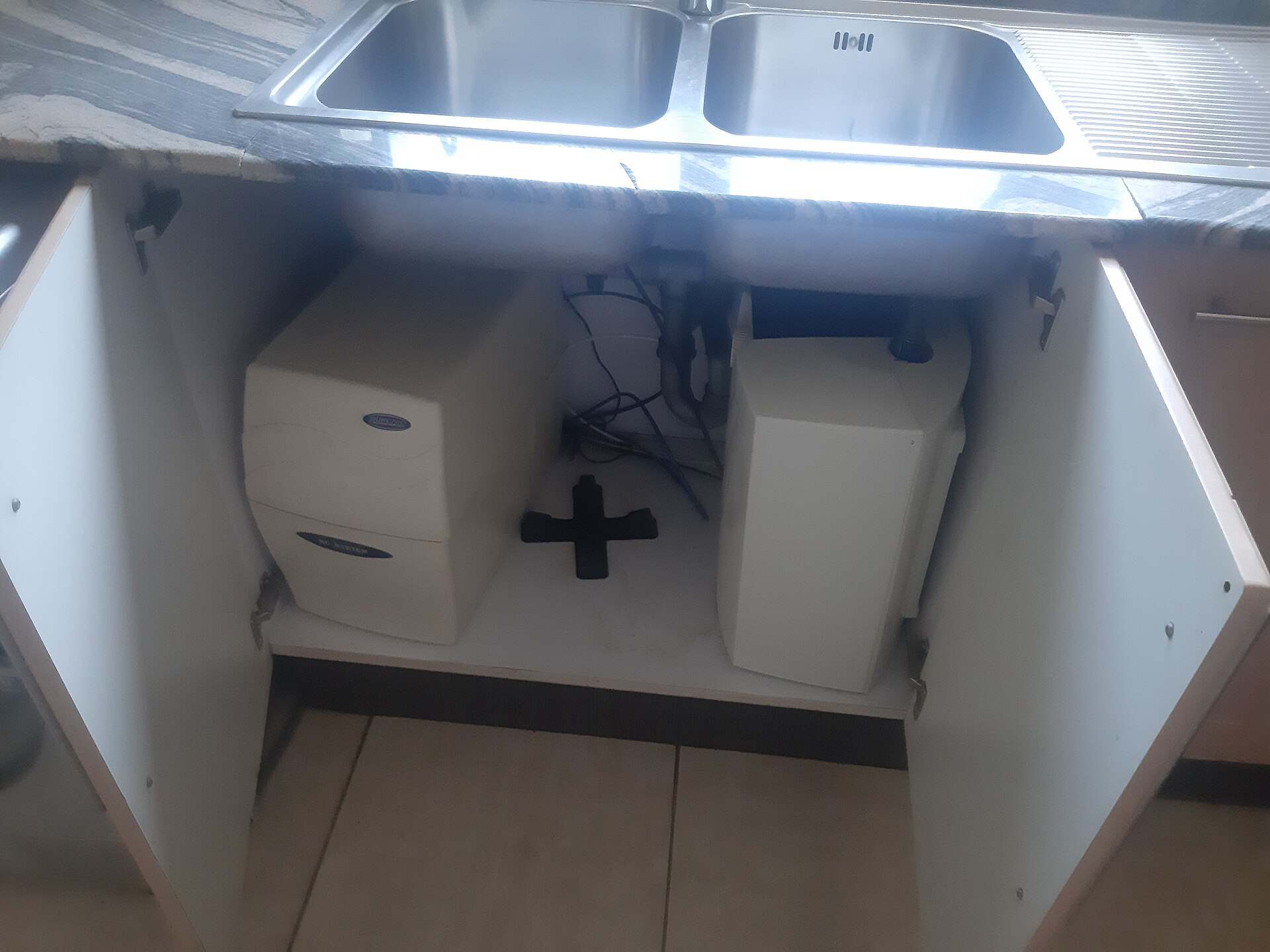
Connecticut’s Department of Public Health (DPH) describes a complete system as an RO module, a storage tank and a separate faucet. Most units add a sediment pre-filter to protect the membrane and an activated carbon post-filter to remove organics and gases the membrane lets through.
Because RO is slow and sends part of the water to the drain, Connecticut DPH says it is not practical to treat all the water entering a home this way. On a well, RO is a point-of-use system for drinking and cooking water, usually under the kitchen sink.
What RO removes, and what it misses
| RO handles well | RO does not handle well |
|---|---|
| Nitrate | Bacteria and viruses (not recommended alone) |
| Lead and copper | Dissolved gases such as hydrogen sulfide and radon |
| Fluoride | Most volatile organic chemicals and solvents |
| Sulfate, chloride, sodium, TDS | Iron particles, which foul the membrane |
| Uranium | House-wide problems like stains, scale and odor |
| Arsenic, in many cases | |
| PFAS (listed by Minnesota’s health department) |
The left column combines Connecticut DPH’s list with the Minnesota Department of Health’s (MDH) treatment table. Removal is never total. Connecticut DPH warns that RO membranes cannot be certified to remove 100% of anything, and performance depends on the membrane, water pressure and contaminant level.
Health problems RO is used for
These are the drinking water results that most often lead well owners to RO. The limits are EPA’s for public water systems, used as benchmarks for private wells.
| Contaminant | EPA limit | First step |
|---|---|---|
| Nitrate | 10 mg/L (ppm) as nitrogen | Don’t use the water for infant formula; use bottled water |
| Arsenic | 0.010 mg/L (10 µg/L, ppb) | MDH recommends taking action above 10 µg/L |
| Uranium | 30 µg/L | Use other drinking water while you plan treatment |
| Lead | 15 µg/L action level (10 µg/L from Nov. 1, 2027) | Stop drinking it; check plumbing and pH |
For nitrate, EPA warns that infants under six months who drink water above the limit could become seriously ill. Call your state health department about any result over these limits. See nitrate, arsenic, uranium and radon and lead.
For lead and copper from corrosive water, Penn State Extension lists RO as an acceptable point-of-use option. It also recommends fixing the pH so the whole house stops dissolving metal.
RO vs other drinking-water options
RO isn’t the only point-of-use choice. The Minnesota Department of Health (MDH) compares several in its home treatment guide:
| Option | What it handles | Trade-offs |
|---|---|---|
| Reverse osmosis | Wide range of dissolved contaminants, including nitrate, arsenic, lead, uranium, PFAS | Wastewater; may need pretreatment |
| Distillation | Wide range, including arsenic, nitrate, lead and bacteria | Energy cost to boil water; water may taste flat |
| Activated alumina media | Arsenic, fluoride, selenium, sulfate, uranium | Effectiveness may depend on pH |
| Iron-based media | Arsenic | May be less effective when phosphate is present |
| Carbon filter | Taste, odor and some certified contaminants, including PFAS in MDH’s study | Bacteria can grow if not replaced on schedule |
MDH estimated point-of-use RO at $300 to $1,500 and distillers at $300 to $1,200, based on 2017 to 2018 quotes. See well water filtration system cost for 2026 ranges.
For nitrate, RO is a common choice because carbon won’t remove it. For arsenic, ask for the unit’s arsenic certification and test the treated water. For lead from corrosive plumbing, fix the pH as well, so the rest of the house stops dissolving metal.
Pretreatment and treatment order
RO is the last step, at one tap. Everything house-wide happens before it:
- Sediment filter.
- pH neutralizer, if needed.
- Iron, manganese and sulfur filter. See whole house well water filters.
- Water softener or tannin filter, if needed.
- UV, if bacteria are a concern.
- RO at the kitchen sink.
Connecticut DPH notes high levels of particulate matter, such as iron particles, can foul or clog the membrane, and MDH says RO may require pretreatment to prevent clogging. Hardness and iron that reach the membrane shorten its life.
Water waste and septic systems
RO always sends some water to the drain. Connecticut DPH’s fact sheet says about 75% of the water fed to a typical unit is wasted: four gallons in for about one gallon of treated water. That figure is from 2009, and wastewater varies by make and model, so check the spec sheet.
If the waste line goes to a septic system, Connecticut DPH strongly recommends keeping RO waste below 30 gallons a day. On a well, wasted water also means more pump run time.
Install needs
- Under-sink space for the filter housings and, on tank models, a storage tank.
- A cold water supply line and a drain connection for the waste line.
- A separate faucet, or a faucet designed for RO.
- Adequate pressure. Connecticut DPH notes household line pressure usually drives RO, but it may need to be increased for good performance. Low-pressure wells may need a booster pump.
Maintenance
- Replace pre- and post-filters on the manufacturer’s schedule.
- Replace the membrane when output drops or test results rise. Clogged or torn membranes need replacement.
- Budget for it. MDH estimates point-of-use RO maintenance at $100 to $200 every one to two years, based on 2017 to 2018 quotes.
- Test raw and treated water. Connecticut DPH says to test both after installation at a state-certified lab, then annually, or quarterly to semi-annually if contaminant levels are high. MDH says to test arsenic-treated water periodically.
Certification and the SpringWell option
For RO, look for a listing under NSF/ANSI Standard 58, which NSF’s database lets you search. Check the specific contaminant claim you need, such as nitrate, arsenic or lead, not just the standard number.
SpringWell sells a MOEN 4-stage under-sink RO system. SpringWell’s page says it reduces contaminants including arsenic, fluoride, TDS and lead. It was listed as out of stock when checked. Its page did not show certification details, so look the model up on the official NSF, WQA or IAPMO listings before relying on a specific claim, especially for bacteria, which Connecticut DPH says RO alone should not be used to treat.
Questions to ask before you buy
- Which contaminants is it certified to reduce, and to what level? Check the listing, not just the box.
- How much treated water does it make per day?
- How much water goes to the drain for each gallon of treated water?
- What do replacement filters and membranes cost, and how often are they due?
- Does it need a booster pump at your well’s pressure, or other pre- or post-treatment?
These follow Connecticut DPH’s list of questions to ask. It also suggests being wary of exaggerated claims and confirming the system was tested and certified by a third party.
Who should skip it
- House-wide nuisance problems. Iron, hardness, sulfur odor and sediment need point-of-entry treatment.
- Bacteria. Shock chlorinate, fix the well and use UV or chlorination.
- Radon or hydrogen sulfide. Gases pass through the membrane.
- Homes with failing septic fields and high water use, unless the waste stream is small.
- Anyone who won’t retest. RO performance fades quietly as the membrane ages.
To check which treatment your numbers point to, enter them at /test-results/.
Common questions
Is reverse osmosis good for well water?
For drinking water, often yes. Connecticut's health department lists nitrate, lead, fluoride, sulfate, uranium and dissolved salts among what RO removes. It is not recommended alone for bacteria, and it needs clear, pretreated water.
Does reverse osmosis remove bacteria from well water?
Don't rely on it. Connecticut DPH says RO units alone are not recommended for treating bacteria. Shock chlorinate, retest and use UV or chlorination if bacteria are a problem.
How much water does a reverse osmosis system waste?
It varies by model. Connecticut DPH's fact sheet says typical units waste about 75% of the water, about four gallons in for each gallon of treated water. Newer designs may do better, so check the unit's spec sheet.
Can reverse osmosis remove arsenic from well water?
RO is one of the options the Minnesota Department of Health lists for arsenic. Removal depends on your water chemistry and the unit, so have the treated water tested after installation to confirm it is below 10 µg/L.
Do I need a water softener before reverse osmosis?
If your water is hard or has iron, treating it upstream protects the membrane. Connecticut DPH notes iron particles can foul or clog RO membranes, and Minnesota's health department says RO may need pretreatment.
Read next
- Nitrate in well waterNitrate above 10 mg/L is unsafe for babies under six months. What your result means, why boiling makes it worse, and how reverse osmosis fits.
- Arsenic in well waterArsenic has no taste or smell, so test once. What 10 µg/L means, why arsenic III needs oxidizing first, and when an under-sink RO system is enough.
- Uranium and radon in well waterUranium is a drinking-water risk; radon in water is mostly an air risk. The levels that matter, how to test each, and why the fixes are different.
- Lead in well waterLead in well water usually comes from plumbing, old pumps or well parts, not the aquifer. How to test first-draw and flushed samples, and what to do next.
Sources
- Connecticut DPH: Reverse Osmosis Treatment of Private Drinking Water Systems (PDF)
- Minnesota Department of Health: Home Water Treatment (PDF)
- EPA: National Primary Drinking Water Regulations
- Minnesota Department of Health: Arsenic in Well Water
- Penn State Extension: Corrosive Water Problems
- NSF: Certified drinking water treatment units listings
- SpringWell: MOEN Reverse Osmosis system